


‘Politics and Eurovision should never mix’ is a mantra that may often be quoted by Eurovision fans. For me politics is a passion as much as my interest in Eurovision. I am hoping to do a few articles on the cross over of politics and Eurovision. There is no better place to start than in my own home country, Ireland and its neighbours, the United Kingdom. For some of my friends from outside Ireland and the UK let me just give a short background to situation with Northern Ireland.
Northern Ireland is at the current point in time belonging to the United Kingdom, however geographically it is connected to the Republic of Ireland. There are two primary communities in Northern Ireland – the Unionist/Loyalists whom wish to remain in a Union with the UK and remain loyal to the crown and the Nationalists/Republicans whom wish to see Northern Ireland join with the Republic of Ireland and see an end to British rule in the North. Out of these groups there were terrorists/freedom fighters depending on your point of view. One of the more well-known groups is the Irish Republican Army (IRA).
There is a strong Eurovision link to all of this. In 1970 Rosemary Marie Scanlon (more commonly known as Dana) represented Ireland with the song ‘All Kinds of Everything’ and marked Ireland’s first victory in the competition. The choice of Dana as the singer for Ireland was somewhat politically sensitive at the time as Dana was from Derry in Northern Ireland, a city with a large Catholic population and very much a flashpoint for troubles. The song itself elicited a feeling of innocence with its lyrics including
“Snowdrops and daffodils butterflies and bees sailboats and fishermen things of the sea wishing-wells wedding bells early morning dew all kinds of everything remind me of you”
The year after Ireland won, the UK sent a young singer from Ballymena in Northern Ireland by the name of Clodagh Rogers. In the book “The Eurovision Song Contest – The Official History” it discusses why Clodagh was chosen. With the troubles in Northern Ireland at boiling point, the BBC felt that Clodagh Rogers would be an ideal candidate for the Eurovision being held in Dublin that year.
There was a lot tension in the air that year however with the choice of Clodagh, this was a choice seen to break the tensions and win over the home crowd. The choice was not a winning one though for the UK as they finished fourth with Monaco winning the 1971 Eurovision Song Contest. It was said soon after that Clodagh had allegedly received threats from the IRA for representing the UK in the Eurovision.
A friend of mine asked me to look at scoring in the Eurovision and if there were any relations to the troubles.


Graphs show possibly no correlation really but what is interesting is the spike in votes from UK to Ireland and the opposite is the case in years 1974-1978. Not possible to say if related to the troubles but there may be a reflection in the attitudes of the time of the Irish public towards the English. All voting was done by juries and not members of the public, but juries may have been influenced at the time by popular opinion.
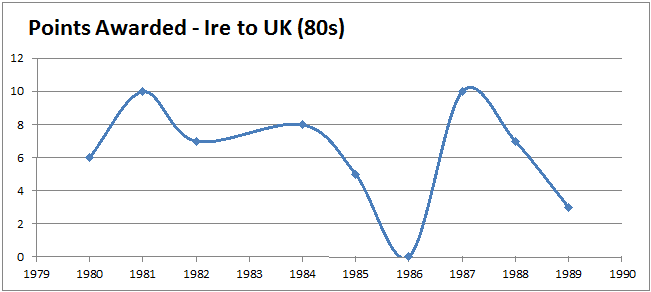

Come the 1980’s the votes appeared to have evened out a bit more. The only year when there were no votes exchanged was 1983 which is down to the strike by RTE technicians that year which resulted in Ireland not taking part. On average over these years Ireland awarded the UK 6.2 points whilst the UK returned the favour with an average of 5 points. This reflects with the graph that things improved significantly over these years.
It’s fair to say that there was an uneasy relationship between the two countries for the 1970’s, at least as from the graphs above the points from the Irish to the UK dropped significantly for a period of the 70s while those from the UK jury rose. Things appear much more level come the 1980s and this gives a more accurate indication as the points system was in use at least then that consisted of the 1-8,10 & 12 points.
Ireland will always have that neighbourly relationship with the UK, the UK even sought to placate by sending over Clodagh Roghers so it’s not all that bad! To this day Graham Norton and his predecessor , Terry Wogan could always be heard to say thank you if we awarded the UK a few points and got them out of a quandary. After all Eurovision is about more than just politics.
Guest Author : Dennis O’Rourke
Categories: Editorial, Eurovision 2015, Ireland, UK


 bogdansteff9
 escppeurovision
 eurovisionireland
 jjs1990
 lisajaynelewis
 philip6
 roydhacksaw
 Eurovision Ireland