


The EBU have revealed the economic impact the Eurovision Song Contest had on Liverpool, in May earlier this year – and it’s all very positive!
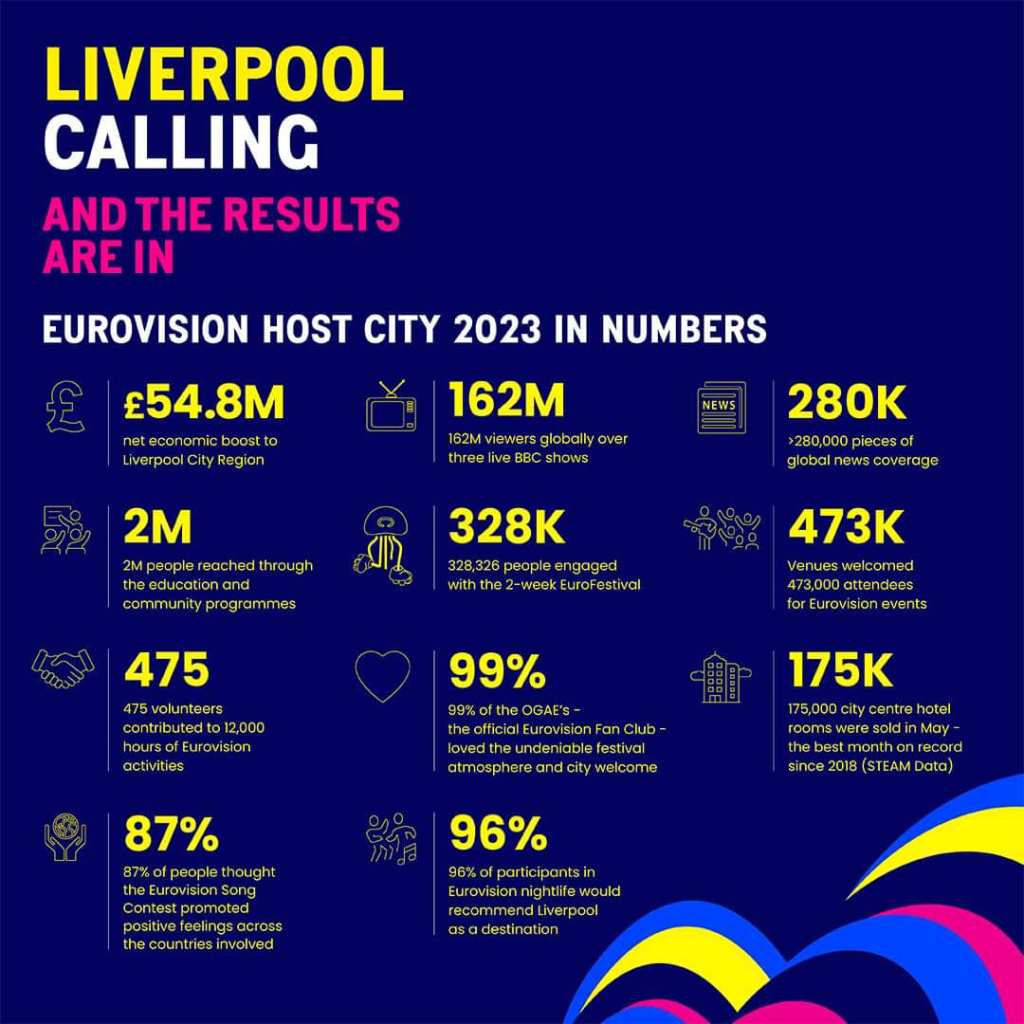
Eurovision boosted the Liverpool City Region economy by £54.8million (net) with restaurants, accommodation providers, shops, bars and transport networks all benefitting. In total 473,000 people attended Eurovision events in the city, with 306,000 additional visitors heading to Liverpool to be part of the celebrations. In May, 175,000 city centre hotel rooms were sold – the best month on record since 2018.
The education and community programmes, EuroStreet and EuroLearn, engaged with 367 organisations and directly with 50,000 people, young and old. The overall programme is estimated to have reached 2 million people. EuroFestival – the Culture Liverpool curated two-week culture festival – presented 24 brand new commissions, 19 of which were in collaboration with Ukrainian artists. A huge 328,346 people engaged with this programme – 557 artists, 1,750 participants involved in a commission and an audience number of 326,039. The official Eurovision Village, located at the Pier Head attracted 250,000 visitors across the ten days it was open, with the ticketed final selling out within hours.
Visitors to Liverpool reported an overwhelmingly positive experience. In a survey, 89 per cent of those questioned, felt it was a safe event and 88 per cent praised its inclusivity. A whopping 96 per cent of those surveyed would recommend Liverpool as a destination to visit and 42 per cent of overseas visitors said the city’s staging of the event had a positive impact on how they viewed the UK. The official Eurovision Fan Club – the OGAEs – carried out a survey and found that 99 per cent of their members felt welcomed in the city and 98 per cent loved the undeniable festival atmosphere. More than 50,000 tonnes of waste was collected throughout the Eurovision period, 80 per cent of which could be recycled.
There was a huge amount of pride around Liverpool being the host city, with 80 per cent of residents noting how important it was for Liverpool and a further 93 per cent saying they were pleased with how the city delivered the event. Of those questioned, 74 per cent were enthusiastic about Liverpool hosting on behalf of Ukraine and 71 per cent felt that the city’s leading role promoted positive feelings across all of the participating nations.
An impressive 475 people provided 12,000 hours of volunteering, covering 350 shifts. The majority (90 per cent) were from the North West of England, and 30 were Ukrainian. A Eurovision job recruitment fair saw 394 jobs offered in one day. A partnership between the BBC and Liverpool Institute for Performing Arts saw 145 students become part of the Eurovision production – in roles such as on stage dancers in the live shows, costume makers or in the TV production team.
Between the period of October 2022, when Liverpool was announced as host city, until end of May 2023, more than 280,000 pieces of global news coverage were generated. The three live BBC shows were watched by 162 million people.
Let us know what you think about the United Kingdom and the 2023 Eurovision Song Contest – either in the comments below or on our FACEBOOK, TWITTER, YOUTUBE, INSTAGRAM and TIKTOK pages.
Author: Richard Taylor
Source: EBU
Categories: EBU, Eurovision 2021, Eurovision 2023, United Kingdom


 bogdansteff9
 escppeurovision
 eurovisionireland
 jjs1990
 John Stanton
 lisajaynelewis
 philip6
 roydhacksaw
 rudsar73
 Eurovision Ireland